Qwen3.8: what Alibaba’s new family changes for local AI in the enterprise
Qwen3.8-27B, released August 14, 2026 under Apache 2.0: multimodal, a 262,000-token context and sharply higher benchmarks. What it means for an SME.
What just happened, in three dates
On August 3, 2026, Alibaba launched Qwen3.8-Max as an API, with a post bearing an ambitious title (“A New Bar for Coding and Cowork”). On August 12, the Qwen team published the weights of the family’s giant: Qwen3.8-2.4T-A95B, the first “Max”-calibre model in the series to be offered for download. And on August 14 at 15:00 UTC, after a two-day slip on the announced schedule that drew plenty of commentary, the official Qwen3.8-27B repository appeared on Hugging Face, Apache 2.0 licence at the top of the model card.
The reception was immediate: more than 600,000 downloads of the 27B on Hugging Face in two days, standard and FP8 builds combined, and one of the most active Hacker News threads of the summer (more than 1,300 points). This is the direct successor to Qwen3.6-27B, the model we have recommended by default since our local model comparison: the upgrade question is therefore a concrete one for any business hosting its own AI.
This article sorts out what is established, what is promising and what remains to be verified. Every figure is attributed to its source; Alibaba’s official scores are identified as such, because no independent replication existed at the time of writing.
Qwen3.8-27B: the real news for an SME
On paper, the 27B ticks every box for a business server. Apache 2.0 licence with no commercial restriction, like its predecessor. Native multimodality from launch: the model accepts text, images and video as input, which makes it possible to read plans, scanned slips and diagrams without a specialized model alongside. A native context of 262,144 tokens, extensible to one million through the YaRN method, with the usual caveat: the model card acknowledges that this static extension can slightly degrade performance on short contexts.
The architecture changes in depth: 27.8 billion parameters spread across 64 hybrid layers, 48 of them Gated DeltaNet linear attention layers and 16 classic attention layers. It is the same shift the entire Chinese large-model industry is making in 2026, and it targets precisely the weak point of dense models: the memory cost of long context. The model ships as a single post-trained checkpoint, with an adjustable reasoning mode (three effort levels) and a direct mode for short answers.
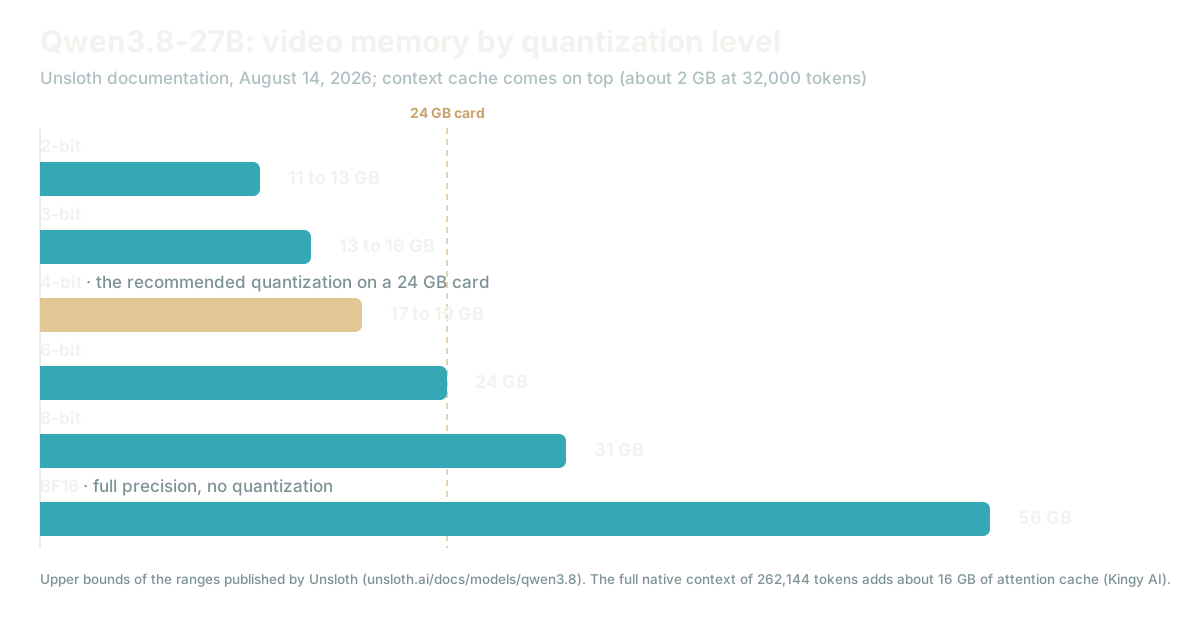
On the hardware side, Unsloth’s documentation puts 4-bit quantization between 17 and 19 GB of video memory and the 6-bit version at 24 GB. A 24 GB card therefore runs the 27B at Q4 with a working context of roughly 32,000 tokens, attention cache included. The full native context is another story: roughly 16 GB of additional cache according to Kingy AI’s analysis. In other words, the server that ran Qwen3.6-27B runs Qwen3.8-27B, at the same C3I tax credit tier for the hardware.
Impressive benchmarks, to be read for what they are
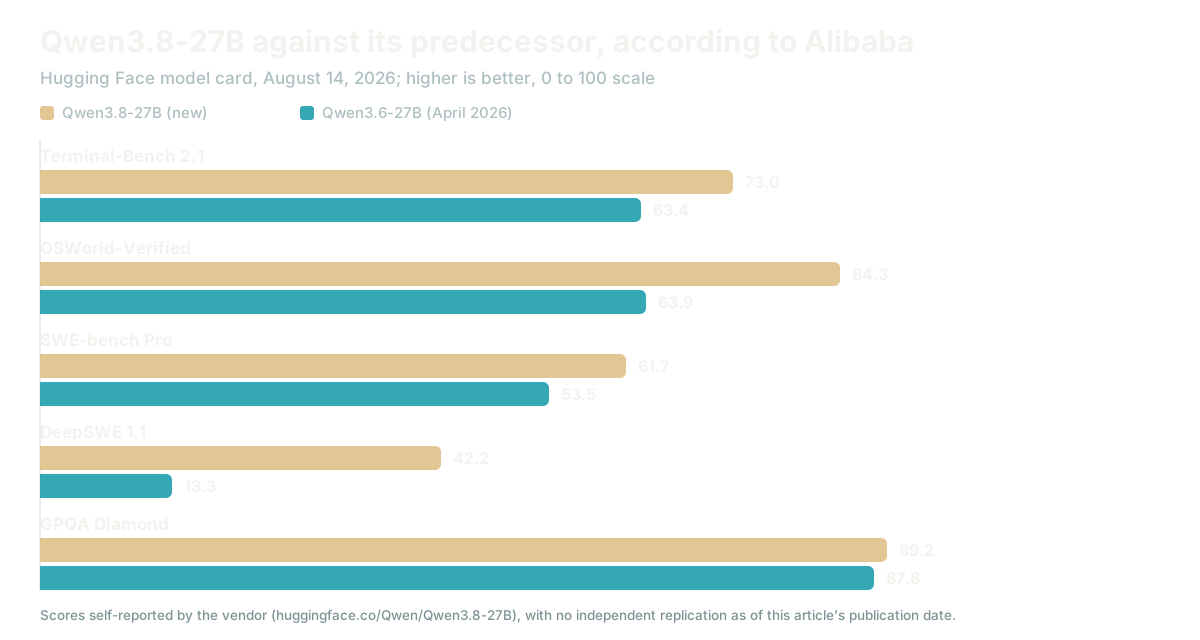
The figures Alibaba published show a real generational jump on agent tasks: 73.0 on Terminal-Bench 2.1 versus 63.4 for Qwen3.6-27B, 61.7 versus 53.5 on SWE-bench Pro, 84.3 versus 63.9 on OSWorld-Verified and a tripling on the DeepSWE 1.1 test (42.2 versus 13.3). Knowledge scores progress more modestly (89.2 versus 87.8 on GPQA Diamond). For a model aimed at enterprise agent workflows, this is exactly the progression profile you want to see.
Three warnings before drawing conclusions. One, all of these figures are self-reported by Alibaba in the model card: no independent replication was available at the time of writing, and Kingy AI’s analysis notes that the comparisons against commercial models were not run under identical conditions. The viral framing “it beats the big closed models” rests on a selection of tests chosen by the vendor. Two, early field reports flag a tendency to overthink: the reasoning mode can stretch on at length over simple tasks if it is not reined in, a family trait already noted in Qwen3.6. Three, vision support in local tooling (llama.cpp and its derivatives) was still being broken in at launch: multimodality on your server may need a few weeks of software maturity.
On the commercial API, the family’s Max version meanwhile earns an Intelligence Index of 58 at Artificial Analysis, tenth worldwide at the time of writing, with throughput judged slow (47 tokens per second) and marked verbosity. It is the family’s only independent measurement to date and it confirms the picture: very strong, not magic.
The 2.4T: an event for the market, not for your server
August’s other release is spectacular on paper: 2.4 trillion total parameters, 95 billion activated per token, 512 experts, hybrid attention and a context extensible to one million tokens. It is the first “Max”-calibre model Qwen has offered for download. But the orders of magnitude disqualify it outright for a business: 4.9 TB of memory at full precision according to the repository card and still roughly 400 GB in the most aggressive quantization available. As a comment in the Hacker News thread summed it up, this is “a server-room object”, built for cloud providers and laboratories.
The licence still deserves attention, because it marks a turning point. Unlike the 27B, the 2.4T abandons Apache 2.0 for a house licence: mandatory attribution of the model in the interface beyond 100 million monthly users or US$20 million in monthly revenue, and a separate commercial licence to offer the model as a service beyond US$50 million in revenue over twelve months. Internal use is explicitly exempted: no SME is affected by these thresholds. The signal lies elsewhere: the big Chinese labs are converging on licences that protect their API revenue, and the all-Apache era for giant models is closing.
A telling detail: the 2.4T’s open weights are text-only and reasoning-mode-only. Vision, the million-token input and the built-in tools remain exclusive to the paid API. The version you download is not the version you rent, and the community noticed. For a business, it is a useful reminder: in local AI, the repository’s model card is the authority, not the press release.
Apache 2.0
the 27B’s licence, with no commercial restriction; the 2.4T, for its part, moves to a house licence with thresholds
≈ 400 GB
the 2.4T’s minimum memory in its most aggressive quantization: out of reach for an SME server
600,000+
downloads of the 27B on Hugging Face in two days, standard and FP8 builds combined
And French, in all of this
This is the launch’s blind spot, and for a Quebec business it is the most important one. Neither the 27B’s model card nor the 2.4T’s publishes a list of supported languages or a single detailed multilingual result: the official benchmarks are labelled English and Chinese. The claim of 119 languages in circulation belongs to the Qwen3 generation of April 2025; nothing allows it to be carried over to Qwen3.8 as is.
Experience with previous generations invites cautious optimism: the French of Qwen3.5 and Qwen3.6 is solid, and it would be surprising for Qwen3.8 to regress. But “surprising” is not an engineering criterion. Before entrusting your quotes and contracts to the newcomer, the only serious method is a head-to-head test on your own documents: same questions, same excerpts, answers compared blind against the incumbent model. It is a one-day exercise and it settles the matter better than any public leaderboard.
What we recommend to our clients
If your assistant already runs on Qwen3.6-27B: no rush. Your hardware runs the replacement the day you decide to switch, the upgrade is an afternoon’s work and the announced gain mostly concerns agent tasks (executing processes, handling tools), less so the quality of document writing. Wait for the first independent replications and test on your corpus. Overthinking is managed from day one by setting the reasoning effort level to the minimum for routine tasks.
If you are starting a local AI project this fall: evaluate both. The multimodal 27B is promising for any workflow that reads scanned documents, plans or job-site photos, a constant need among our manufacturing clients. Its model card is recent, its ecosystem is maturing by the day (community GGUF files appeared the very day of the launch) and its licence is beyond reproach. The final choice belongs to the head-to-head test, not to the news cycle.
And if you are still weighing hosting against subscribing, that question comes before the model question: our local AI versus public cloud business case lays out the legal and economic terms of the debate. One more model in the open catalogue, however strong, does not change the conclusion: models come and go, the infrastructure and the data remain.
Frequently asked questions
Does Qwen3.8-27B replace Qwen3.6-27B as the default choice?
Not yet. The announced gains are real on paper, but all of the figures come from Alibaba with no independent replication, French behaviour is not documented and field experience is measured in days. Our default recommendation remains Qwen3.6-27B; Qwen3.8’s 27B becomes a candidate for the job as soon as a benchmark on your own documents gives it the edge.
Does the model fit on a 24 GB GPU?
Yes, at 4-bit quantization: 17 to 19 GB according to Unsloth’s documentation, which leaves room for a working context of roughly 32,000 tokens. The full native context of 262,144 tokens is another matter: the attention cache then claims roughly 16 GB more, which knocks out the 24 GB card. For most enterprise document uses, 32,000 tokens are more than enough.
Are the “it beats the big closed models” scores reliable?
Handle them with care. The comparisons Alibaba published were not run under identical conditions for every model, cover a selection of tests chosen by the vendor and had no independent replication at launch. The only third-party measurement available covers the family’s Max API: tenth worldwide on Artificial Analysis’s Intelligence Index, with slow throughput. Strong, then, but not to the point of erasing the gap with the best commercial models on the hardest tasks.
Is the 2.4T’s house licence a risk for a business?
Not for an SME: internal use is explicitly exempted and the thresholds (100 million monthly users, US$20 million in monthly revenue for attribution, US$50 million over twelve months for commercial service) are off the scale. The real issue lies elsewhere: the 2.4T demands roughly 400 GB of memory at the strict minimum, which reserves it for data centres. The 27B, the only model relevant to an SME, remains under Apache 2.0 with no strings attached.
Does the 27B’s vision already work on a local server?
It is being broken in. The model is natively multimodal, but at launch vision support in llama.cpp and the tools derived from it was not complete, and the official entry in the Ollama catalogue may take time. Community quantized files appeared the same day; allow a few weeks for the toolchain to stabilize before building a production workflow on image reading.
Do you need a new server to move to Qwen3.8-27B?
No. The memory footprint is the same as Qwen3.6-27B’s: a 24 GB GPU covers 4-bit quantization with a comfortable working context. A server bought for the previous generation therefore remains fully relevant, and the hardware stays eligible for the C3I tax credit under the same conditions.
Sources and references
- Official Qwen3.8-27B Hugging Face model card (specifications, benchmarks, Apache 2.0 licence)
- Official Qwen3.8-2.4T-A95B Hugging Face model card (architecture, text-only weights)
- Full text of the 2.4T house licence (attribution and commercial service thresholds)
- Official 27B announcement, Qwen team on X (August 14, 2026)
- Unsloth, Qwen3.8 documentation (memory required by quantization, recommended settings)
- Kingy AI, technical analysis of Qwen3.8-27B (attention cache, benchmark conditions)
- Artificial Analysis, independent evaluation of Qwen3.8-Max (Intelligence Index, throughput)
- MarkTechPost, general availability of Qwen3.8-Max (August 3, 2026, API pricing)
- Hacker News thread on the 27B launch (field reports, overthinking)
- Forkast, analysis of the 2.4T licence (“a platform play, not a gift”)
- BigGo Finance, the convergence of Chinese mega-models (Qwen3.8 and Kimi K3)
This article is a plain-language summary, accurate as of the date shown. It is not legal advice: for your own situation, consult a legal adviser or contact the Commission d’accès à l’information.
Read next
Sovereignty
Top 5 AI models to host on your own servers in 2026: an honest comparison
Read →
Strategy
Local AI or public cloud: the complete business case to justify your choice
Read →
Funding
AI funding in Quebec in 2026: who pays for what, and how to build an application
Read →
A question about your own compliance?
The discovery call is free and takes half an hour. You leave with an honest read on your situation.
Let’s talk