Metal fabricationManufacturing SME, Granby
Les Industries Romy
Fabricator and installer of steel structures for heavy industry, the industrial sector and construction
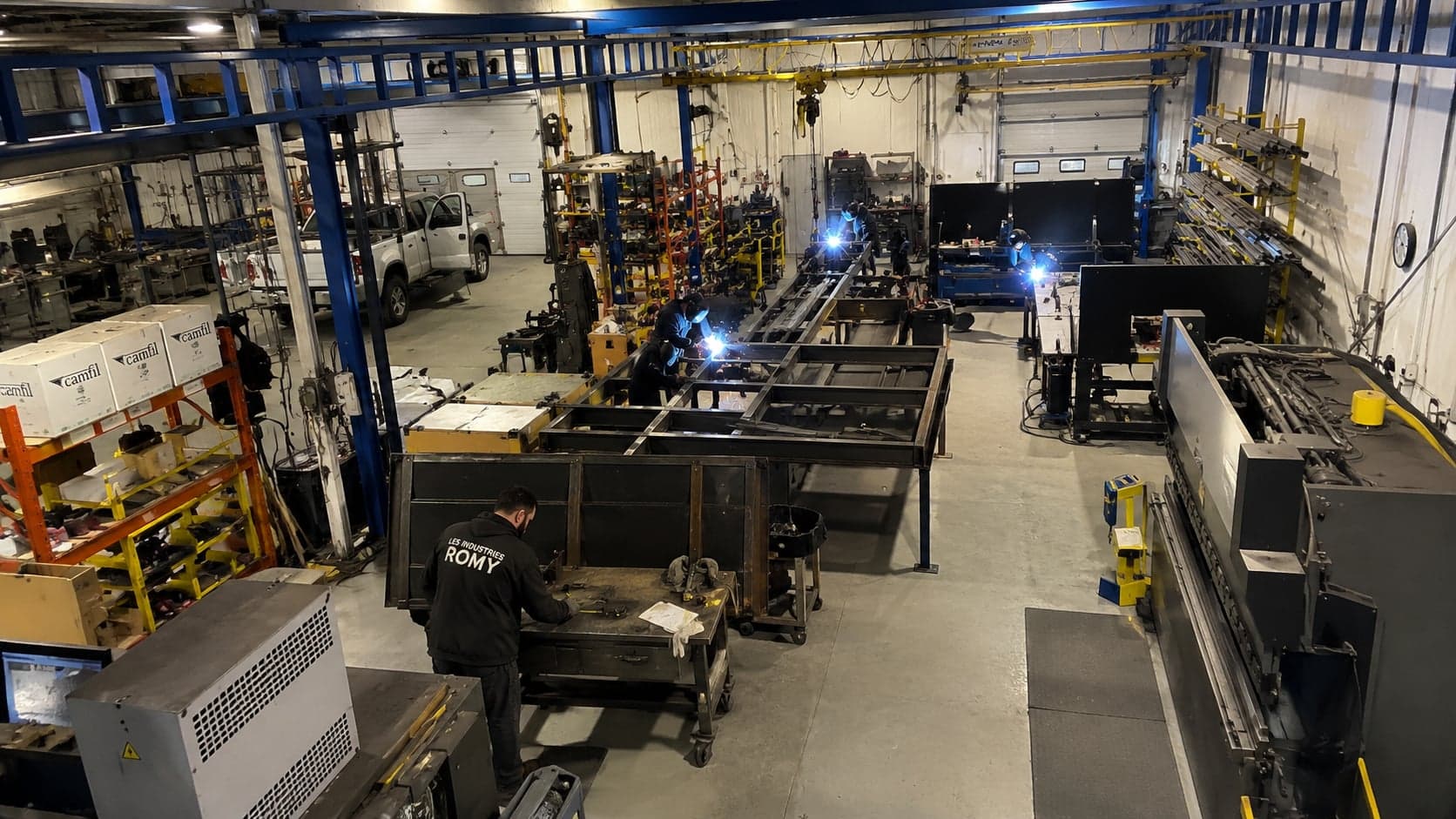
I’ve been running Les Industries Romy for ten years, a steel structure plant in Granby. We serve the industrial, institutional and construction markets. That mix kept us busy year after year, and it went a long way in making the company a success.
Then the American tariffs hit and slowed our growth. The price of raw materials went up and orders from our regular clients dropped a lot. To stay in the race and win new clients, we needed time to prospect. Yet our three project managers spent only 8% of their time on it, on average. The rest disappeared into admin work that added nothing, and a lot of it could be eliminated or handed over to AI, in whole or in part.
To keep my company alive and keep it growing, I decided to put AI to work and automate our administrative processes.
The context
Estimating, project tracking and accounting all rested on a handful of key people, and the information sat dormant in inboxes and network folders. The company wanted a team of agents that worked inside its own data, inside the tools it already used, and above all on its own server.
The challenges
- Supplier invoices keyed in by hand
- Labour and material costs not tracked per project: no way to know the total spend on a job
- Forgotten follow-ups: 16 quotes had been sitting for more than 90 days, some for 900
- Estimating and project tracking spread across several in-house tools that did not talk to each other
The system we built
The processes the system now handles, on video.
The quoting process, assisted by AI
A quote request taken from end to end: the email comes in, the missing details are requested from the client, the project file is created, the estimate is prepared, the quote goes out, and it is followed up until it is accepted.
The four gains
01
Time management
The morning briefing replaces the old round-table: what is urgent today, in thirty seconds, drawn from the register and the pipeline. No more digging through three systems to find out where a job stands. Anything that has been dragging for two years is counted separately: set aside from the morning, not forgotten.
02
Administration
The administrative assistant follows instructions written in advance, defined entirely through dropdown menus: what, from where, to where, how often, up to what amount, who approves. Below the set amount, it acts on its own and leaves a trace. Above it, it posts a card and waits.
03
Project management
Every job carries its official number, its costs, its schedule and its drawings. Follow-ups fire on their own and are drafted ahead of time. A project analysis runs in one click, and it names what is missing to close it out instead of showing a reassuring zero.
04
Accounting
Supplier invoices arrive by email, are read, matched to the project and written into QuickBooks through the API. Job costing builds up as the work happens rather than at month end.
The savings
Drafter
1 person · from 40 to 4.8 hours a week
88%
of the time freed up
The agent reads the sketches and prepares the shop drawings in DXF, with every version archived. The drafter no longer produces the sheets: they review them, adjust them and approve them. Nothing is sealed without them.
Project managers
3 people · from 120 to 10.8 hours a week
91%
of the time freed up
Job tracking, follow-ups, quote preparation, coordination and written summaries are all automated. Client relationships and judgment are not: that is where the three project managers reinvest their hours.
Accounting
1 person · from 16 to 3.68 hours a week
77%
of the time freed up
Keying in invoices is gone. The agent reads the ones that arrive by email, matches them to the right project and prepares them for QuickBooks. Accounting reviews and approves instead of typing.
157 hrs
freed up per week
8,149 hrs
freed up per year
$407,472
in salary savings per year
Your industry has its own constraints. Let’s talk about them
Every enterprise brain is different: yours starts with a free discovery call and an honest read on what you could get out of it.
Let’s talk about your project