Local AI or public cloud: the complete business case to justify your choice
The legal, economic and operational arguments that justify local AI to an executive team, backed by verified figures, and the limits worth admitting.

First, agree on the terms of the debate
“Local AI or public cloud” covers two different decisions, and mixing them derails the discussion. The first is a tool decision: whether or not to give your employees ChatGPT, Copilot or Claude subscriptions. Our subscription comparison covers it in detail, verified prices included. The second is an infrastructure decision: where the artificial intelligence that will read your quotes, your contracts and your production data will run. That one commits the company for years, and it is the one this article equips you for.
By local AI, we mean an open-weight model (Qwen, Gemma, Mistral and company, see our model comparison) running on a server you own, inside your walls or at a Canadian-owned host in Quebec. By public cloud, we mean the APIs and subscriptions of the large American providers, whatever the geographic region of their servers: we will see why that nuance matters more than everything else.
What follows is a business case, not a closing argument: every figure is attributed to its source and the last section lists the cases where the public cloud remains the right choice. A case that hides its weaknesses does not survive the first question from a board of directors.
The legal argument: Law 25 and the CLOUD Act
Law 25 requires a privacy impact assessment before personal information is communicated outside Quebec (section 17 of the private-sector act, CQLR c. P-39.1) and before any information system project that processes it (section 3.3). Sending your customers’ emails, your employee files or your quotes into an American provider’s API is precisely such a communication: the assessment must demonstrate that the information would receive adequate protection. It can be done, but it is a compliance file to assemble, defend and keep current. A model running on your server in Quebec makes the transfer question disappear: our PIA guide shows the difference on the documents themselves.
The 2018 U.S. CLOUD Act adds the decisive argument: it compels providers subject to American law to hand over the data in their custody to the authorities, no matter where it is hosted. An American cloud giant’s Montreal region therefore remains under American jurisdiction, because what counts is the owner, not the data centre’s postal code. Our CLOUD Act analysis details the mechanics. A server you own answers to no foreign provider: the immunity comes from the architecture, not from a contract clause.
The penalties give the argument its weight: Law 25 provides for administrative monetary penalties of up to $10 million or 2% of worldwide revenue and penal fines of up to $25 million or 4%. Before a board, the question “why invest in a server?” then turns around: why accept a recurring legal risk when the alternative is an asset?
The economic argument: the per-seat bill versus the asset
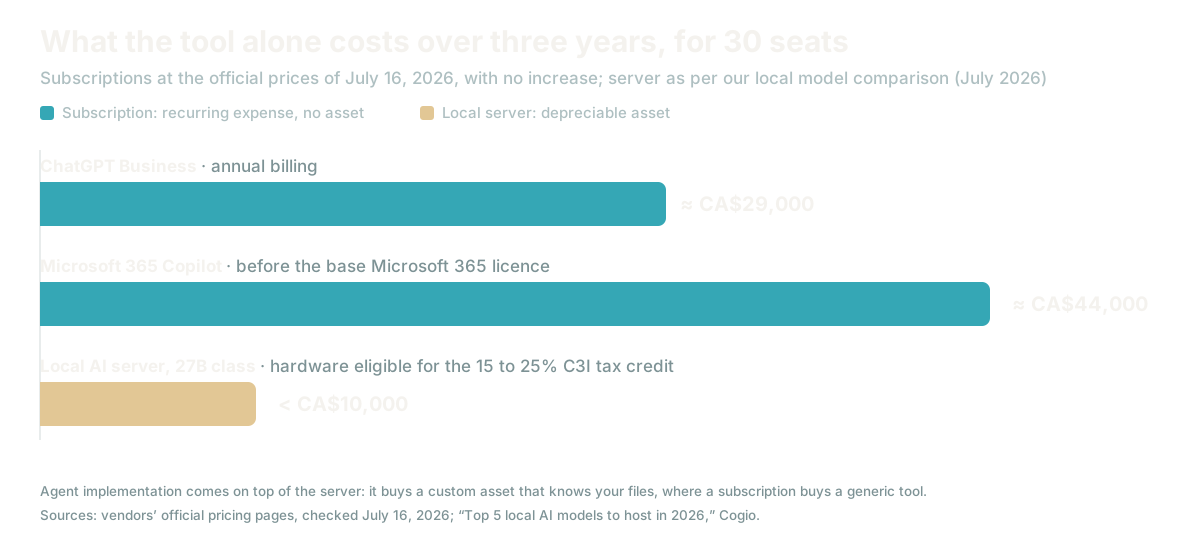
Let us lay out the figures, all verified on the vendors’ official pages on July 16, 2026 in our subscription comparison. ChatGPT Business costs CA$27 per user per month billed annually; Microsoft 365 Copilot costs CA$40.70, on top of an eligible Microsoft 365 licence; Claude Team costs US$20 per standard seat. Over three years and 30 users, without a single price increase, that comes to around CA$29,000 for ChatGPT Business and around CA$44,000 for Copilot before the base licence. At 100 users, multiply by more than three. And at the end of those three years, nothing remains: no hardware, no software, no accumulated knowledge that belongs to you.
On the other side, a server capable of running a 27B-class model, our default recommendation for an SME, can be found under $10,000 according to our model comparison. That hardware can qualify for Revenu Québec’s C3I tax credit (15% to 25% depending on the region, on the portion above the $5,000 threshold). Putting a first agent into production (the software, the integration with your tools, the commissioning) comes on top; that is what turns the server into a business result, and it is a fundable project: our overview of Quebec funding details ESSOR, NRC IRAP and the other levers that regularly cover 30% to 50% of an eligible project.
The accounting difference matters as much as the amounts: the subscription is a perpetual operating expense, indexed to the provider’s price increases and to your headcount; the server and its agents are a depreciable capital asset, whose marginal cost per additional user is close to zero. A growing business watches the first bill swell every year and the second spread ever thinner.
The operational argument: what a subscription will never do
The argument least often made to executive teams is nonetheless the most concrete. A generic subscription knows nothing of your procedures, your quote templates or your project history: every employee starts from scratch in a chat window. A local AI learns your documents through RAG, plugs into your systems (email, accounting, ERP, document management) and executes your processes instead of commenting on them. At Les Industries Romy, a structural steel fabricator in Granby, shop drawings, quotes and accounts payable now run on the company’s own server, under human validation.
Governance follows the same logic. On your server, every query and every answer can be logged on your premises, access is controlled by your own rules and personal information is redacted before any processing. The terms of service do not shift under your feet: nobody can unilaterally amend the contract of a server you own. And reversibility is observed rather than negotiated: models under the Apache 2.0 licence, documented configurations, data that never left your walls.
That leaves dependency: a business whose critical processes rest on a third party’s API adds a link it controls neither technically nor commercially. The provider can withdraw a model, change its prices or degrade a version without meaningful notice. It is an ordinary business continuity risk, and it is managed like the others: by taking it out of the equation when the stakes justify it.
What the business case must admit to stay credible
First, raw quality. The largest cloud models remain superior to SME-sized open models on the hardest tasks: long reasoning, complex code, open-ended questions outside your documents. For a business document assistant, context closes most of the gap: an open model that reads your documents beats a giant that has never seen them. But the claim “local equals cloud at everything” would not survive a demonstration, so do not make it.
Second, the initial investment and the skills. The cloud starts up within an hour with no capital outlay; local requires a server, an integration and someone to maintain it, in-house or through a partner. Managed maintenance exists precisely for that, but it has to be budgeted.
Third, measuring the gain. In April 2026, Statistics Canada published an analysis that puts expectations in their place: the raw productivity gap between AI-using firms and the others (16.8%) shrinks to 5.1% once complementary investments in cloud computing, R&D and training are taken into account. In other words, neither local nor cloud produces a gain by mere presence: the complete project, clean data and training included, is what produces it. Our ROI measurement method draws the practical consequences.
Finally, hybrid is often the real answer: sensitive data and business processes on the local server, generic tasks with no personal information (translating a public document, a general search) on a subscription. The business case does not aim to ban the cloud; it aims to keep your company data from passing through it by default.
The one-page memo for your executive team
Here is the business case condensed, in the order in which it convinces. Every line points back to a verifiable fact in this article or its sources.
$25M or 4%
the ceiling on Law 25 penal fines: the compliance argument comes with numbers too
CA$44,000
30 Copilot subscriptions over 36 months at the official July 2026 price, before the base Microsoft 365 licence
15% to 25%
C3I tax credit on the inference server, depending on the region, above the $5,000 threshold
- Compliance: local AI eliminates the question of transfers outside Quebec (section 17, Law 25) and simplifies the privacy impact assessment required before any project (section 3.3). The public cloud demands one and demands that it be kept current, on pain of penalties of up to $25M or 4% of worldwide revenue.
- Jurisdiction: the CLOUD Act follows the provider’s owner, not the server’s address. A “Canadian” region of an American provider remains subject to American law; a server you own does not.
- Costs: 30 Copilot subscriptions over three years cost around CA$44,000 before the base licence (official July 2026 prices) and leave no asset. A 27B-class server costs under $10,000, qualifies for the C3I (15% to 25%) and the implementation can be funded (ESSOR, NRC IRAP).
- Accounting nature: a perpetual operating expense versus a depreciable capital asset with a near-zero marginal cost per added user.
- Capability: a local agent schooled in your files executes your processes (quotes, drawings, accounting at Les Industries Romy); a generic subscription comments on yours without knowing them.
- Control: an audit trail on your premises, terms of service that do not move, verifiable reversibility (Apache 2.0, data that never left). No provider can withdraw the service.
- Honesty: the cloud giants stay ahead on the hardest tasks, the cloud starts without capital, and the gain comes from the complete project (Statistics Canada, April 2026), not from the mere presence of an AI. A well-governed hybrid is often the answer.
Frequently asked questions
Is using ChatGPT or Copilot illegal under Law 25?
No. Law 25 does not prohibit the public cloud: it requires a privacy impact assessment demonstrating that personal information communicated outside Quebec would receive adequate protection (section 17), contracts to match and governance kept up to date. It is a recurring documentation burden, not a prohibition. Local AI makes that burden disappear for the data that never leaves.
Does an American provider’s Montreal region not settle the question?
No. The 2018 CLOUD Act compels providers subject to American law to hand over data in their custody regardless of the hosting country. Jurisdiction follows the provider’s owner, not the data centre’s location. A server located in Montreal but operated by an American company therefore remains exposed.
Is a local model less capable than a cloud model?
On the hardest tasks, yes: the largest commercial models keep the edge. On business tasks (answering from your documents, preparing a quote, classifying and extracting), a 27B-class open model schooled in your files does better than a giant that does not know them. The right question is not “which model is the strongest?” but “which one knows your business?”
What does local AI really cost, all in?
Three line items: the server (under $10,000 for the 27B class, $25,000 to $35,000 for a high-end dual-GPU machine, eligible for the C3I), putting the first agent into production ($15,000 to $40,000 according to our July 2026 reference prices) and upkeep (managed maintenance plans starting at $800 a month). Funding programs (ESSOR, NRC IRAP) regularly cut the net bill by 30% to 50% on the eligible portion.
Can local AI and public cloud subscriptions be combined?
Yes, and it is often the sensible architecture: sensitive data and business processes on the local server, generic uses with no personal information on subscriptions governed by a clear usage policy. What matters is that the default path for your company documents is the one you control.
What remains if our integrator or our vendor disappears?
With well-built local AI: everything. The models are under the Apache 2.0 licence, the configurations are delivered to you documented and the data never left your servers. That is the difference between owning an asset and renting a service: one survives its supplier, the other dies with the subscription.
Sources and references
- Law 25, CQLR c. P-39.1 (ss. 3.3 and 17, penalties), Légis Québec
- CLOUD Act (H.R. 4943, 115th U.S. Congress), Congress.gov
- Li and Liu, “The role of complementary capabilities in artificial intelligence adoption and productivity,” Statistics Canada, Economic and Social Reports, April 22, 2026
- Revenu Québec, tax credit for investment and innovation (C3I)
- Commission d’accès à l’information du Québec, communication of personal information outside Quebec
This article is a plain-language summary, accurate as of the date shown. It is not legal advice: for your own situation, consult a legal adviser or contact the Commission d’accès à l’information.
Read next
Sovereignty
Local AI or ChatGPT Enterprise: an honest comparison for a Quebec SME
Read →
Sovereignty
CLOUD Act: why a server in Montreal is not always sovereign
Read →
Sovereignty
Top 5 AI models to host on your own servers in 2026: an honest comparison
Read →
Strategy
How to measure the ROI of an AI assistant: the recovered-hours method
Read →
A question about your own compliance?
The discovery call is free and takes half an hour. You leave with an honest read on your situation.
Let’s talk